Your company page reaches 5% of the feed; personal profiles reach 65%. In the LinkedIn personal profile vs company page comparison, it is not a question of content: it is how LinkedIn is designed. Understanding it changes how you should use each one.
In this article
The 5% and the 65%: the difference in reach
When you post from the company page, your content reaches a small part of the feed. When the same content comes from a personal profile, the reach is much greater. It does not depend on the quality of what you write, but on how the platform distributes content from people and from brands.
Engagement: 4.7% against 1-2%
The difference shows in engagement too. An analysis of 52 million posts recorded an average of 4.7% on personal profiles, against 1-2% for company pages. If you have a page and get no response, you are not necessarily doing it wrong: you are using the tool in the way the platform favours least.
Why LinkedIn treats people and brands differently
The reason is simple: LinkedIn treats people as conversation and brands as advertising. And people comment on other people, not on a logo. In the LinkedIn personal profile vs company page comparison, the profile has a structural advantage when the goal is to open dialogue.
Do not close the page: stop expecting it to work alone
This does not mean closing the company page. It means no longer expecting it to work on its own. The page remains a point of reference: anyone looking for your company, whether a customer or a candidate, opens it to check that it exists and is serious.
What really works on LinkedIn
- Let a real person speak. The founder, the manager, the team: a name and a face build more trust than a brand.
- Look after the first 60 minutes. LinkedIn decides a post’s reach by the conversations it starts in the first hour. Three real comments early on are worth more than a hundred late likes.
- Use the page for what it is good at. Credibility, announcements and hiring, not for generating organic conversation.
How to decide who gives your company a face
When choosing between a LinkedIn personal profile vs company page, the practical question is who is going to speak. A simple method:
- Choose one or two people who know the work well and are comfortable writing.
- Define the topics they can speak about with authority: their daily work, the mistakes they see, what they have learned.
- Use the page to repost and add context, not to replace people’s voices.
- Spend the first hour after posting replying to comments.
To make sure people who discover those voices land on a website that really explains what you do, see how we work on web development and SEO.
The irony of posting this from a company page
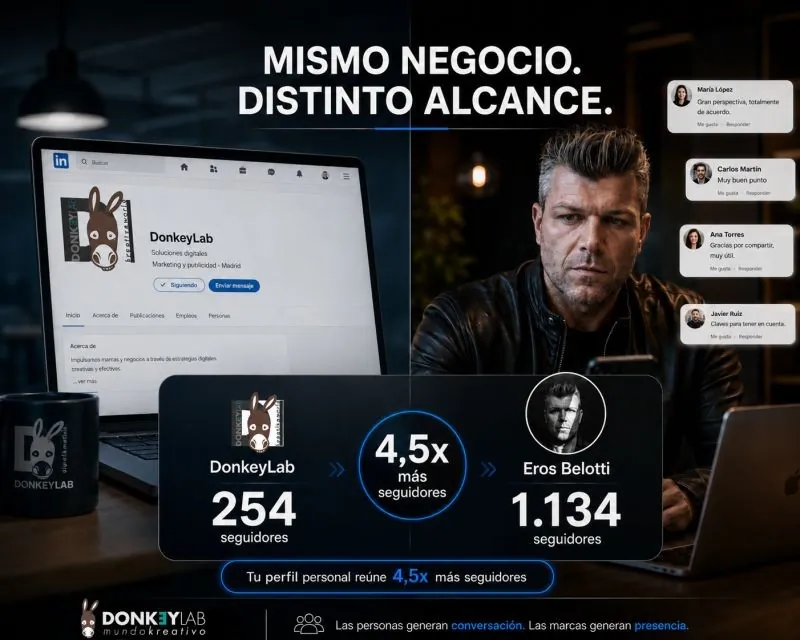
Yes, we are aware of the irony of publishing this from a company page. That is precisely why we know what we are talking about: we have lived it, which is why we get our most significant results from the founder’s personal profile. You can see our LinkedIn page and compare.
Frequently asked questions about LinkedIn personal profile vs company page
Should I close the company page?
No. It works as a reference point for credibility, announcements and hiring; you just need to stop expecting it to generate conversation on its own.
Why do personal profiles have more reach?
Because LinkedIn treats people as conversation and brands as advertising, and people comment on other people, not on a logo.
What counts in the first hour after posting?
Conversations: according to the analysis cited, three real comments early on are worth more than a hundred late likes.
Who should speak for the company?
One or two people who know the work, such as the founder or a manager, with the page reposting and adding context.
Want a LinkedIn presence that starts conversations?
We can help you decide voices, topics and the role of the page, and prepare the website that welcomes the people who arrive.